September 23, 2009

Obama on Settlements


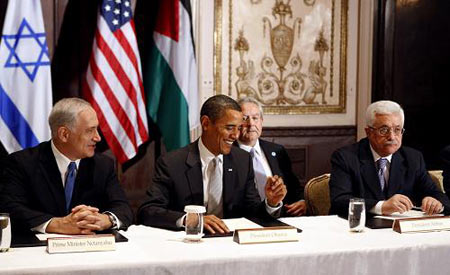
Maayana Miskin published the article Obama Orders Israel to 'End the Occupation' on the Israeli News site Arutz 7. Her article looks at the comments made by the Obama Administration made To the United Nations General Assembly, following a meeting Obama had with Israeli PM Benjamin Netanyahu, and Palestinian National Authority Leader Mahmud Abbas. The intent of the meeting was to open lines of communication between the feuding countries, but the major topic at hand was that of Israeli settlements in the West Bank. Included within Obama's comments were a candid conviction towards Israel; "End the occupation that began in 1967," and that The U.S. “does not accept the legitimacy of continued Israeli settlements.” Obama believes that the ending of the settlements is a pre-condition to talks regarding a two-state solution.

The Issue of Settlements and the Israeli position has been one of much controversy and bad publicity regarding Israel, as well as an issue that has put a strain on the relationship between the United States and Israel. The areas of Judea and Samara were part of the areas conquered by Israel during the Six-day war in 1967. Since then settlements have been built in Sinai, the Gaza Strip, the West bank, East Jerusalem and the Golan Heights. The Settlements in Sinai and Gaza have been withdrawn from these areas (The Sinai in 1982 and the Gaza Strip in 2005), but the others still exist. Currently, the 2008 data from the Foundation For Middle East Peace has the settlement population of the West Bank at 285,800 (121 Settlements), and the total settlement population in all the areas combined is 484,862.

During the meeting on Tuesday, Obama demanded that Israel freeze the building of any new settlements in Judea and Samaria, a request that Israeli PM Netanyahu refuses to comply with. Netanyahu argues that the settlements are within the “national consensus” regarding towns that are expected to remain in Israeli hands permanently, making them legal. Regardless of the legality of the settlements, Obama called on Israel to make concessions towards the Palestinians and accept some of their demands. “The United States does Israel no favors when we fail to couple an unwavering commitment to its security with an insistence that Israel respect the legitimate claims and rights of the Palestinians.” Obama is placing much pressure on Israel; even Former United States ambassador to the UN John Bolton said “Obama has put Israel on the chopping block.”

Although much of the focus was put on Israeli actions, Obama still delivered a message to UN member states demanding that they “avoid vitriolic attacks on Israel and recognize Israel's legitimacy.” He also called on the Palestinian Authority to “end incitement against Israel.”

This article is a legitimate representation of the comments made by President Obama, and clearly illustrates the stance that the Obama Administration has taken in regards to settlements and their immediate immobilization. It accurately showed comments made both to Israel and members of the U.N who have a different view of the issue.

This is a dangerous time for any kinks to arise in the historically smooth functioning of cogs within the Israel-United States allegiance machine. This warning from Obama comes at a very problematic time for Israel, and puts them in precarious position. Currently Israel’s national security is being threatened by Iran’s capability of firing long-range missiles, and their overt desire to acquire Nuclear Arms. This whole situation makes me quite curious. Is an attack on Iran on the Horizon? Will Israel be the one to initiate the attack? Will it be in compliance with the U.N and the United States? Will the Obama administration support Israel no matter the case? Will he leave them hanging? Is Israel willing to agree on major political concessions in order to secure U.S support? All of these questions baffle me, and I am afraid of the answers to each. Not only am I afraid of the answers, because they all involve killing, the loss of lives, and international stability. The political ramifications of any kind of attack, and the subsequent uproar Israel would receive. The population of Israel is estimated at 6 million, and the total population of Jews in the world is 13 million. Iran’s population is nearing 68 million, with 98% of its citizens being Muslim. The Muslim population in the world is estimated to be around 1.5 billion. I cannot even begin to imagine the kind of uproar a nation like that can create. Frankly, I am very frightened. Iran scares me. Ahmadinejad scares me.

I can only hope for the best and cross my fingers that diplomacy will help avoid blood and destruction. These tensions between the U.S and Israel, and the recklessness displayed by Iran are situations we should pay attention to, I can sense that this is a precursor for tension, and shows that this issue is being closely followed by the Obama Administration and the rest of the world.

September 8, 2009

Humanitarian Crisis In Gaza

Avi Issacharoff, correspondent of Haaretz Newspaper, has written an article entitled "Most Gazans killed in war were civilians," in regards to a new report being published by The Israeli information center for human rights in the occupied territories, also known as, B'Tselem. This report refers to Operation Cast Lead, the operation conducted in Gaza by Israeli troops last winter. This study refutes previous claims made by the Israel Defense Force, who claimed the number of casualties to be much lower at the time of the Operation. The numbers however, do not lie: "According to B'Tselem, 1,387 Palestinians were killed during the three weeks of Operation Cast Lead, of whom 773 were noncombatants and only 330 were combatants."

The numbers gathered by B'Tselem are much more comprehensive then that of the IDF's, the result is that the numbers presented by the IDF are significantly lower then that of B'Tselem. “According to B'Tselem, 1,387 Palestinians were killed during the three weeks of Operation Cast Lead, of whom 773 were noncombatants and only 330 were combatants. The IDF, in contrast, claims that 1,166 Palestinians were killed during Cast Lead, of whom 709 were Hamas combatants and 295 were civilians.” B’Tselem says their information is legitimate and accurate, garnering their information from eyewitness sources, death certificates, in-house IDF investigations, and lists prepared by Palestinian human rights organizations.

The article itself is very credible and non-biased; it simply reports the facts of the B’Tselem report. The report, however, could very well be misleading, inaccurate and wrong. B’Tselem didn’t count armed Hamas police officers as combatants, but as civilians, and the some of the methods they use could be very subjective. Eyewitness reports without evidence are hardly 100% accurate, and the numbers gathered by Palestinian human rights organizations could very well be inaccurate as well. Regardless of which number is more correct than the other, 1,406 lives lost is 1,406 lives too many. Even though Israel tries very adamantly to avoid the deaths of the innocent, Hamas makes it practically impossible to avoid civilian casualties. Former Secretary of State Condoleeza Rice states "Hamas participates in activities like human shields and using buildings that are not designated as military buildings to hide their fighters," she told reporters. "So it's hard." Hamas also sets up military bases near schools and other densely populated areas to increase the number of casualties. Hamas also base themselves in civilian homes, set up their bases near schools and hospitals, use Mosques to hide their guns and ammunition, and make sure to fight in areas teeming most with innocent civilians. Their intent? To skew the numbers in order to receive sympathy and squander Israel’s credibility.


The civilians in Gaza live in a very precarious position. I do not believe that this Operation was the cause of this humanitarian crisis in Gaza, but it really highlights examples of how the helpless civilians of Palestine are used as political pawns by the Arab Nations. The unemployment rate in Gaza is between 60-80%. Food, basic supplies and medicine are all expensive, rare or non-existent. This attack was another blow to their crumbling and non-functional infrastructure. In 2007, when Hamas won the majority seats in the Palestinian Parliamentary elections, ousting Fattah, a bitter and bloody rift between the two groups ensued. As a result, the members of Hamas who served on the Palestinian National Authority in the West Bank were kicked out, leaving the Fattah in control of the West Bank, and Hamas in control of Gaza. Many people give grief and lay blame with the citizens’ of Gaza because it was they who elected Hamas to power, however, you cannot expect a people on the brink of desperation living in such a destitute state to understand or thoroughly contemplate the political implications of electing Hamas to power. Correct, Hamas stands on a platform of irrational and persistent violence towards the Israeli's, but I highly doubt that any Palestinian civilians’ mind are bombarded by those thoughts when they don’t even live with the certainty of a promised tomorrow.

After the election and the Battle of Gaza (which caused extensive damage in Gaza and many deaths), Mohammed Abbas, leader of the Fattah, outlawed the Hamas Militia. At that point both Israel and Egypt sealed their borders into Palestine, literally trapping the people within it. From that point until the start of the Operation, Hamas retaliated by sending countless mortar shells into the southern towns of Israel. In late December 2008, when the rocket fire became too persistent and dangerous to ignore any longer, the IDF threatened action against Gaza. Those threats were not heeded, and in thinking for the best interest of their civilian’s freedom, Israel attacked. First by air, and when Hamas still refused to cooperate, they sent combatants in by foot. Israel tried many times to negotiate a cease-fire with Hamas, but they refused. Before the offensive, Israel sent out messages on Arab radios stating that they will invade, and also dropped leaflets on civilian homes warning them that if there house is used as a base to fight, they will be targeted. Also, during the fighting, Israel proposed a three-hour cease-fire every night to allow in humanitarian supplies. Even during these cease-fires, Hamas would not cease firing missiles. Conversely, Hamas sent out text messages in Hebrew to Israeli civilians warning them "Rockets on all cities, shelters will not protect you," and threatening Israeli Soldiers by setting up booby traps and broadcasting messages with their intent to kidnap soldiers.

Estimates claim that Gaza lost nearly $2 billion in assets, including 4,000 homes, destroyed 600–700 factories, small industries, and business enterprises, 24 mosques, 31 security compounds, 10 water or sewage lines, and 34 health facilities. Over 50,000 people in Gaza became homeless as a result. Hamas garners a lot of negative attention for their destructive behavior, but never is the focus and emphasis on the reconstruction of Gaza on its civilians. The quality of life in Gaza is extremely poor; 80% of the citizens rely on humanitarian aide to survive. The people of Gaza rarely get support from the other Arab Nations, those nations only use Gaza as a provocation of Israel and use them as a way to fulfill their agenda of destroying Israel and the lives within it. Israel sees a lot of the blame for the humanitarian crisis because they seal the borders, however no one is giving the same kind of attention to the blockade Egypt has imposed a well.

I did not choose this article to lay blame on any one person or country. I wrote about it to make a collective call to all the nations of the world to help those in need. It is extremely disparaging to see a group of people who are in such need, and at the same time ignored by the whole world; even those who claim to be on their side. I think it is an extremely important issue, I don't think anybody should suffer that way. Unfortunately, at the same time that the Palestinians are struggling, a lot of hate and racism is pointed towards them. Attention should be paid to everyone around the world who do not have basic necessities like food and water, and those who have bleak futures. Hopefully by reading this I can encourage you to be more aware, to give back, or volunteer your time and efforts to those who need it. The World really needs more people who care about it.