December 1, 2009

The Bedouins are my Pushers


Israel is comprised of many different contentious groups of people, all with very distinct and differing beliefs. Israeli government and society struggle to balance the ideologies of the religious Israelis, the non-religious Israelis, the Zionists, the anti-Zionists, and the several different groups of Arabs and Israelis who all live in Israel and who are interspersed within the country. One of these distinct groups of Israeli Arabs are the Bedouin people. They are Arabs who are Muslim, and are a semi-nomadic tribe that dwell in semi-permanent houses, and herd sheep requiring grazing land. A large population of the Bedouins in Israel live in the southern Desert region of the country, called the Negev. Although they are both Arab and Muslim, they see themselves as unique, and call themselves the “People of the desert,” and the “original Arabs.” Even through their self-classification, it is evident that the Bedouin also clash with different Muslims, and are not inclusive to people outside their tribe. The distinctions are kept apparent, and that contributes with internal struggles in their community, as well as conflict with Israel’s government, and the people living under their authority.

The Bedouin refuse to accept basic humanistic principles that pervade within Israeli society, and many other western, modernized countries. They live a strictly patriarchal lifestyle, which practices polygamy, female subordination, does not emphasize education, and a large percentage of them live in poverty. Israel has offered them alternatives to their lifestyles, but they are too willing to refuse, not wanting to give up precious land. They believe they have legitimate claims to the land they settle on, and much more of it has been stolen or taken by Jewish landowners. The Bedouin have a very antediluvian lifestyle, and have never paid head to the obligations of a responsible landowner or citizen. The Israeli government requires landowners to register their land and pay taxes, concepts rejected by the Bedouin. They don’t pay taxes, however they are frustrated when there is no electricity, or phone lines in their homes, and that pipes are laid for running water and sewage. The Israeli government has tried to accommodate and help the Bedouin by offering social services and setting up towns and villages with schools and clinics, but the Bedouin are extremely rooted to their way of life and many adamantly refuse these services.

Although Israel seems to be offering a lot to help the Bedouin, the Bedouin have grown increasingly hostile towards Israel, and constantly comment on their feelings of suppression and inferior stature within Israeli society.

How do you speak of reason with people who do not even share core humanistic values expected to be intrinsic in people? It is difficult to compromise and help people who themselves do not want to be helped. Although they believe they have a claim to the land they reside on, the Bedouin have a completely different set of religious and social values that do not translate to egalitarian democratic societies. Rosenthal gives us a perfect example: “Under Bedouin law, relatives of a murdered man can attack any male member of the murderers family, all the way up to a fifth-degree male relative with absolutely no connection to the crime (288).”

Since the Bedouin are condemned to live such a meager and destitute lifestyle, Israel worries about outside influences, which might allure the Bedouins and make them a threat. Israel worries about the appeal of more radical Islamic groups who have the ability to influence and recruit the Bedouins. Poverty is one of the main reasons of these fears, as some Bedouins of the younger generation have become criminals in order to make money. When once there were no problems within Bedouin society in terms of juvenile delinquency, crimes and drug use, it has become more and more rampant recently. “Bedouin men have been caught smuggling prostitutes, arms, and narcotics across the borders with the West Bank, Gaza, and Egypt (288).” Bedouin are not exclusive to Israel, they span across many countries in the Middle East, and are strong in numbers, and many of them practice smuggling through these countries. Israel faces the threat of smuggling from all their borders, and struggle with the surrounding countries that do not impose the law or regulate these Bedouin smugglers. Many Bedouin communities also exist in the Sinai desert, outside of Israel’s jurisdiction, in Egypt.

The article I chose regards those Bedouin who live in the Sinai desert region, which connects Egypt to Israel, and Egypt’s unwillingness to pursue and punish those Bedouins who are smuggling narcotics and ammunition into Gaza and Israel.

I found an article on Strategypage.com, a website that categorizes itself as a website geared towards reporting on Military actions across the globe. They had an article relating to the Bedouin people, and the prevalence of the smuggling across borders, and the unwillingness of the Egyptians government to crack down on these smugglers. The article is entitled “Why Egypt Won't Mess With The Bedouins,” and addresses the political deterrents in why Egypt won implement more stringent laws on smugglers. The article speaks of a Dictatorship disguised as a democracy, and the corruption within the government and police officials that just let the smuggling disseminate. They promise to take action, yet years have passed in between these promises and no actions have been taken. Egypt in careful to tread lightly and not rub anyone the wrong way, especially Hamas and the pro-Palestinians living within Egypt.

The article also discusses that the Bedouin are involved with this smuggling, and deal with Drugs, weapons, and even human trafficking. They are also able to make a lot of money by smuggling basic goods into Gaza that may be scarce. The Bedouin are also not afraid to fight and defend themselves, and it creates a problem for the Egyptian government who do not want to stir up any controversy by snuffing them out by force.

…

My concerns in reading the article are that they Bedouin are extremely knowledgeable and talented in their familiarity with the Desert, and their ability to navigate these mountains and landscapes with accuracy. It is easier for them to outwit border control and outsmart any kind of anti-smuggling units. I am also inclined to believe that although Bedouins stick with their tribes, they have connections and relationships with other Bedouin who are spread across many Middle Eastern countries. These relationships, coupled with their astuteness in other areas can make them very good at what they do. Especially when the Bedouin outside of Israel are living autonomously, in countries that don’t enforce laws or have austere attitudes towards illegal activity.

November 18, 2009

Haredi Women: Forced lifestyle or Chosen?


The term Haredim comes from Isaiah 66:2, where it translates to “those who tremble before God.” They literally do. They are Ultra-Orthodox, the most religiously devout denomination of Judaism. They strive to maintain Eastern European traditions which stretch back hundreds of centuries. Their population in Israel is approximately half a million, 12% of the overall population. Although a small group, the Haredim are very controversial as well, and they stir up a lot of disagreement around many different issues. They do not recognize any other denomination of Judaism as legitimate, and they want Israel to be primarily a religious country, meaning that the entire country should have to abide by the same strict laws the Ultra-Orthodox do, without exception. They also have a lot of influence politically as well, as “their political power could make or break government coalitions (Rosenthal: 176).” Exemptions like being able to evade the military draft in order to study in a Yeshiva, and government subsidies that support the Haredim and their large families, are reasons the Haredim are separate the rest of Israeli society , and explains the great divide between them.

The chapter on Haredim in the book showed the way Haredim families and communities function. They keep themselves separate in many ways, and really live a strict, law abiding and predictable life. 70% of Israeli Haredim men do not work. Instead they study the five books of Moses, and their commentaries in Institutions dedicated to teaching the scriptures of Judaism. Benjamin, a Haredi Israeli living near Mea Shearim, states, “study is my livelihood and Talmud my profession. The spiritual wealth of learning the Talmud is worth more than any paycheck (Rosenthal: 177).” Out of 500,000 Haredim in Israel, 70% of the men do not have a job. If you estimate that half the Haredi population is male, that means approximately 175,000 Haredim are not working. Where, might you ask, do they get the money to support themselves and their ample children?

The women. The women are the primary breadwinners in a Haredi household, and combined with government stipends, it is their paycheck that supports the families. Sarah, a Haredi women has found herself successful in a business venture, making and supplying fashionable wigs to Haredi women. She sees working as her duty, and is very proud to support her husband’s studies. “Back when Jews lived in shetls and ghettoes, people were so poor they were busy just trying to find enough to eat. So how many men could afford a life of spiritual study? Very few, I tell you. To study Torah and Talmud is the ultimate mitzvah: everything is there. Everything. Laws, ethics, and history. And even psychology. Its like the ocean, so vast, so deep (Rosenthal: 177).” It is kind of Ironic, they way Sarah talks about the scriptures when women aren’t allowed to deeply study the texts and commentaries of the Torah. Sarah, as well as most of the Haredi community lives a very frugal life, and do not have extra money or disposable income; not like they care either. Sarah believes, “What we don’t have in money, we have in spirituality.”

In an article by Jonathan Rosenblum entitled “The Feminie Mystique,” Rosenblum critiques an article written by Haaretz reporter Orit Shohat, about Haredi women and their inability to choose. Rosenblum’s article mainly focuses on this inflammatory passage.

The claim that Haredi Jewish women freely choose to bring 12 children into the world is about as solid as the claim that there are women who freely choose to become prostitutes or paid surrogate mothers. If it were not for their emotional misery and if it were not for the social pressure they are under and the state of abject poverty in which they live, haredi women would not opt for a life of slavery. It is doubtful whether most ever had the opportunity to make any personal choices whatsoever in their lives.

Rosenblum rebuts her argument by seeking out Haredi women, and proving that Shohat’s criticisms of Haredi women are unfounded and untrue. There are voices of women in the article who have also chosen to become ultra-Orthodox, even though they were not raised observant. The opinions of these women were consistent, and their type of lifestyle, faultless. They love what they do and cannot imagine a different kind of life. They find a lot of meaning in what they do, and they both choose to live it and choose to believe it.

November 9, 2009

Mizrahim's marganilization in Israeli society.

The Chapters about the Ashkenazi, Mizrahi, Russian and Ethiopian Jews of Israel gives a better idea of the kind of diverse ethnic melting pot that constitutes Israel. It is easy to look at Israel and classify it as just one entity that comprises a specific group of people, but that could not be more inaccurate. Israel is an immigrant country; the “Israeli’s” of today are culturally and ethnically diverse, and the people have extremely different geographic backgrounds.

Throughout Israel’s history there has been controversy within these groups in itself-different rungs of the socio-economic ladder that unfortunately puts Jews of some backgrounds subservient. A lot of the way the class system shaped out has to do with the waves of immigration, and those who came first. The Ashkenazim were the first to arrive in Israel long before its Establishment as a state. They were the “Haluztim” or pioneers who tilled the soil, set up the kibbutzim, and were responsible for the early creation and successes of the Military. In the beginnings of the state, Mizrahim were non-existent. It wasn’t until after the creation of the state that Jews of Mizrahi descent began to emigrate in large numbers. “From 1948 through the 1960s, 870,000 Mizrahi Jews fled Yemen, Iraq, Egypt, Syria, Lebanon, Morocco, Tunisia, Libya, Iran and Afghanistan; more than six hundred thousand refugees came to Israel (Rosenthal: 225).” Until the arrival of the Mizrahi Jews in Israel, both groups were seemingly unaware of one another, and the Ashkenazi Jews were perplexed by the similarity between the cultures and customs of Mizrahi Jews and its similarity to Arab Culture. Rather than understand their cultural differences, the Ashkenazi groups instead “sought to transform them into models of themselves: secular, socialist Ashkenazi Israelis (116).”

arabjews.jpg

Mizrahi Jews from Yemen

Naomi Kehati immigrated to Israel from Yemen at a young age, and was given a scholarship to go to an Ashkenazi school. “Our schoolbooks were written from an Ashkenazi perspective. At home, nothing reflected what I had learned at school. We studied about the Jews of Europe, about the pogroms in Russia. The trauma of the holocaust overshadowed everything…I was losing myself in their world. I learned about the heroic pioneers, all Ashkenazim, who established a new state and the kibbutzim, but not the stories of the other half of our people-people like me, the poor Mizrahim, the Arab Jews. I wanted to belong but my story was not in the books. Our culture didn’t seem to count (Rosenthal: 114).”

The Holocaust however was the major difference in the demographics of Jews, and really changed whom was the majority. Most of the 6 million Jews killed were Ashkenazi, as well as the Sephardic Jews of Eastern Europe. Before 1950, Ashkenazim were 80% of Israel’s population, and were in control of the important aspects of the country. However, following 1960, the scale began tipping in the opposite direction, and Mizrahim comprised 60% of the population. At this time Israel was in dire need of physical laborers: Agriculture and factory workers, and soldiers. The Ashkenazi’s placed all these new immigrants in agricultural settlements, and marginalized them into being the lower-working class of Israel. The places they sent them to were the most controversial, undesirable, and dangerous. “Although few Mizrahim knew about planting grapefruit or cucumbers, many were sent to work in Kibbutz fields. Moroccan’s, Tunisians, Iraqis and Yemenites started two hundred Moshavim that helped protect dangerous border areas. Other Mizrahi extended families. Accustomed to living in close-knit communities, were split up and sent to far flung ‘development’ towns in the Galilee, the Jordan Valley or the arid Negev where many got jobs in construction or textiles, food, and other low-tech factories. Israel’s poor development towns and neglected urban areas are now home to their children and grandchildren-Israel’s lower class (120).”

I found a blog post regarding the war between Israel and Gaza in late 2008 early 2009, and these Mizrahim Jews who are still living in these border towns. The blog is dedicated to writing about Mizrahi Jews, referring to the content in her blog as “Information and links about the Middle East's forgotten Jewish refugees.” The title of the post is “Mizrahi Jews of southern Israel are 'cannon fodder',” and refers to the lack of mention of those Israelis who were subject to the attacks of Hamas living in these southern border towns. These are the places that are threatened most by rocket fire and attacks, and there is no coincidence why these areas are densely populated with Mizrahi Jews. She quotes writer Smadar Lavie, a Mizrahi Israeli Jew on her view of the Ashkenazi-Mizrahi relationship, and how they are being used by the Ashkenazi elite, and are fooled by the fake interest the Ashkenazim show in the retention of their culture and traditions. The quote that was most poignant to me was when Lavie states that “from 1948 on, the self-proclaimed socialist Ashkenazi-Zionist regime purposefully settled them as cannon fodder in the border zones of the state they had carved out of Palestine. The regime planted the Mizrahim in villages from which it had expelled the Palestinians, in order to prevent their inalienable right of return home.” Although I do not agree with the first part of the statement, I agree with the latter. The Ashkenazi Jews were not trying sending Jews to their death, they obviously never expected the kind of violence that has occurred, and in no way could they predict how the issue has escalated from then to present time. I do think that her comments have some truth in them, although she exaggerates and twists the facts.

Personally I do not believe in the concept of a real Jew or the original Jew. A Jew is Jew. I do find it hard that Mizrahim are considered as lesser citizens. The Mizrahim are the actual Semites of the Middle East where Judaism was born. I don't know why it is so hard to notice or understand. They come from a Judeo Christian Islamic world that birthed 3 religions, and linguistically are historically the people who spoke Semitic languages. There should not be such a power struggle or desire to classify certain people as the best, and others as lower citizens. I feel like a country with the history and people of Israel should understand this better than most, but its not just them, most of the world is uneducated and misinformed about all the different groups of Jews that come from all over the world.

November 4, 2009

Soldiers and Mental Health


The story of sergeant Eli Rosenfeld, part of the famous Golani Infantry Brigade, gives the reader a more focused look on how Israel models its society and children to strive for militaristic success. It shows Israel’s dependence on their young citizens to protect to existence of Israel and the people within it.

From a very young age the Israeli youth are encouraged to look forward to their duty as Israeli servicemen. The influence of family members and programs like the “Tzofim,” prepare teenagers for the army.

Sergeant Rosenfeld speaks of how his Parents both have doctorates, and moved to Israel from California. He states that his family puts a large emphasis on education, when asked why he decided to be a combat soldier, Eli answered, “To be in infantry, to defend my country, that’s what I was educated for. At home and in my [religious] school learned about our deep connection to this land and to love it (Rosenthal: 58).” Eli’s rank and responsibility in the army show a common practice of the IDF, which involves “giving enormous responsibility to young non-commissioned officers like the twenty-one-year old Eli (Rosenthal: 61).”

Eli’s commentary gives perspective to the several split-second decisions that can be the difference of life and death. He portrays the difficulty of assessing certain situations in mere seconds. “If you shoot too quickly, you may kill an innocent boy. If you wait too long, you and other may be killed (Rosenthal: 61).” He also spoke about the added difficulty of fighting a war without clear a clear from or a clear distinction between civilians and soldiers. Eli recounts the pain of witnessing and processing the death of close friends and comrades, and struggling to justify the situation in his mind. T him, the threat is never neutralized and no matter where you are you could be a victim.

Eli’s reflection of the death and destruction he witnessed at such a young age exposed the traumatic feelings he was internally coping with. “No one trained me to deal with this…No psychologist. No counseling... They expect us to be tough even though we are falling apart (Rosenthal: 61).” A very poignant quote of Eli’s really makes one assess the responsibility they had at the same age, and the toll it takes on your life and youth: “My parents say I went in a boy and came out a man. That being a soldier mad me serious, mature. Well, id rather be immature and happy. I’ve lost three years of my life. I envy eighteen year olds in America who are worrying about college instead of about remaining alive (Rosenthal: 61).”

Eli’s glimpses of post traumatic stress and comments about the absence of mental health n the army is really a window into a huge a prevalent issue that exists among Israeli youth and war veterans. Eli’s comments indicate that this is an issue that soldiers do commonly struggle with, and that the army does not offer help n this regard.

Unfortunately, it is common for soldiers to experience high levels of stress and anxiety after a war or traumatic experience, however if not dealt with properly, it could lead to more severe mental health issues and other illicit practices.

The Yoav Shamir made a documentary on the BBC entitled: “Flipping Out - Israel's Drug Generation,” which brings dome focus and sheds light on the problem of PTSD in Israel, and how many of those who struggle with the disorder seek solace from drugs. His video focuses more on Israeli veterans who travel to India in order to use drugs, but the beginning of the video really puts into perspective how many soldiers struggle on a daily basis. Although Eli did not pack up to pursue a drug filled adventure, it sheds light on the root of the problem, and exposes it as a problem. Hopefully the IDF will adopt a more understanding approach to its war veterans, and make council and resources available to them. It is distressing that the brave soldiers who fought and still fight as reserves suffer so much, and help is not available to them so they seek out other means of coping.


Part 1 of 6 Installments


Part 2, Part 3, Part 4, Part 5, Part 6

October 7, 2009

Common enemy: Iran


U.N General Assembly

In the New York Times article entitled “Is Ahmadinejad a ‘Gift’ for Israel?,” Robert Mackay examines the statements made by Israeli Prime Minister Benjamin Netanyahu, Iran’s President Mahmud Ahmadinejad, and President Obama made in during the 64th Session of UN General Assembly that met between the15th and 30th of September. The article specifically follows a speech made by Benjamin Netanyahu to the Assembly intended to rebut Ahmadinejad repeated claims that the Holocaust did not occur. Netanyahu took to the podium the day after Ahmadinejad addressed the assembly with a racist and intolerant speech. He did not mention the Holocaust, however he had mentioned its legitimacy the week before. Instead of focusing on the domestic issues within Israel, Netanyahu chose to directly rebuke the claims that Ahmadinejad and other holocaust deniers have made. He brought documentation to back up his arguments as well: the minutes of the Wansee conference, the construction plans of the Auschwitz-Birkenau Concentration Camp. Netanyahu also questioned the legitimacy of the U.N and condemned them for allowing Ahmadinejad to have platform. Things reached a boiling point on Friday, when it was discovered that Iran was close to completing a second Nuclear facility, and had been doing so in secrecy. All eyes were focused on Iran and their obvious pursuit of nuclear arms.

I found Mackay to be extremely fair in boiling down the ramifications of the week’s proceedings. I can tell he is balanced and well represented. He looks at the events that unfolded during those three days, and evaluates how it affected Israel and how it also affected Palestine. He begins his article describing how PLO Chairman Mahmud Abbas drew the short end of the stick when he was scheduled to speak Friday, the same day that news of Iran’s nuclear plants became first-page news, and Obama’s stern stance subjugated the headlines. Before this week Abbas truly believed himself to be in a better place; he was coming off the heels a meeting where Obama gave a stringent demands to Netanyahu and the outcome seemed to favor Palestine. Abbas truly believed that talks would center and focus on Israel’s refusal to stop expensing its settlements in the West Bank. Also taking attention away from the settlement issue in Palestinian territories was the fact that Netanyahu forwent speaking about it in his address to the General assembly on Wednesday, and only concentrated on the Holocaust and Iran’s desire to acquire nuclear weapons. While Mackay represents how the Palestinians got shafted, he explains how it is a winning situation for Israel. The issue of settlements is a very contentious one that doesn’t usually favor Israel, and Israel managed to completely avoid the issue during the U.N General Assembly. They definitely lucked out that the news of Iran’s nuclear plant surfaced two days after anti-Ahmadinejad rallies took place, and Obama issued a statement reproachful of Iran.

Haaretz Newspaper reported in an article last year that Prime Minister Ehud Olmert, told Time magazine that Israeli hardliners were wrong to say that Iran posed an “existential threat” to Israel. “Iran’s achievement,” the former intelligence official said, “is creating an image of itself as a scary superpower when it’s really a paper tiger.” I don’t know if that would change now that Iran has shown that it has the capability to build Nuclear weapons in the next three years, but hopefully it’s a true statement. I don’t think the week could have gone better for Israel. Not only did they avoid taking heat over the settlements, but they found a uniting spark between its allies. It was absolutely brilliant that Netanyahu presented historical records to back of the Holocaust and invalidate the many claims Ahmadinejad has made. It was a genius move on his part not to mention the settlements, and a large stroke of luck that the news broke of Iran’s Nuclear facility the day after, and really gave ethos to Israel as many have united against Iran. Previous to the week’s events, Israeli and U.S relations were threatening to be derailed over the issue of settlements, and Israel’s non-compliance with U.S demands. The threat of a Nuclear Iran, and the anti-Semitic remarks made by Ahmadinejad has put both Israel and U.S on a united front against the same enemy; priority one is preventing Iran from acquiring nuclear arms and neutralizing any threat. Obama realizes the Iran is the most dangerous issue at hand, and for the time being, all other things are not going to be in such clear focus. Even former intelligence chief, Ephraim Halevy, called Mr. Ahmadinejad a “gift,” since his inflammatory anti-Israel rhetoric “unites the entire world against Iran.”

September 23, 2009

Obama on Settlements


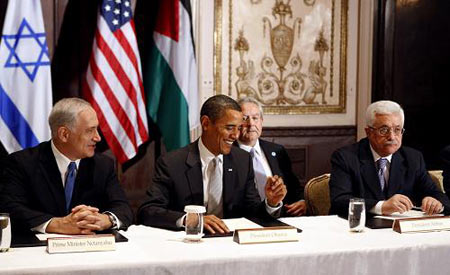
Maayana Miskin published the article Obama Orders Israel to 'End the Occupation' on the Israeli News site Arutz 7. Her article looks at the comments made by the Obama Administration made To the United Nations General Assembly, following a meeting Obama had with Israeli PM Benjamin Netanyahu, and Palestinian National Authority Leader Mahmud Abbas. The intent of the meeting was to open lines of communication between the feuding countries, but the major topic at hand was that of Israeli settlements in the West Bank. Included within Obama's comments were a candid conviction towards Israel; "End the occupation that began in 1967," and that The U.S. “does not accept the legitimacy of continued Israeli settlements.” Obama believes that the ending of the settlements is a pre-condition to talks regarding a two-state solution.

The Issue of Settlements and the Israeli position has been one of much controversy and bad publicity regarding Israel, as well as an issue that has put a strain on the relationship between the United States and Israel. The areas of Judea and Samara were part of the areas conquered by Israel during the Six-day war in 1967. Since then settlements have been built in Sinai, the Gaza Strip, the West bank, East Jerusalem and the Golan Heights. The Settlements in Sinai and Gaza have been withdrawn from these areas (The Sinai in 1982 and the Gaza Strip in 2005), but the others still exist. Currently, the 2008 data from the Foundation For Middle East Peace has the settlement population of the West Bank at 285,800 (121 Settlements), and the total settlement population in all the areas combined is 484,862.

During the meeting on Tuesday, Obama demanded that Israel freeze the building of any new settlements in Judea and Samaria, a request that Israeli PM Netanyahu refuses to comply with. Netanyahu argues that the settlements are within the “national consensus” regarding towns that are expected to remain in Israeli hands permanently, making them legal. Regardless of the legality of the settlements, Obama called on Israel to make concessions towards the Palestinians and accept some of their demands. “The United States does Israel no favors when we fail to couple an unwavering commitment to its security with an insistence that Israel respect the legitimate claims and rights of the Palestinians.” Obama is placing much pressure on Israel; even Former United States ambassador to the UN John Bolton said “Obama has put Israel on the chopping block.”

Although much of the focus was put on Israeli actions, Obama still delivered a message to UN member states demanding that they “avoid vitriolic attacks on Israel and recognize Israel's legitimacy.” He also called on the Palestinian Authority to “end incitement against Israel.”

This article is a legitimate representation of the comments made by President Obama, and clearly illustrates the stance that the Obama Administration has taken in regards to settlements and their immediate immobilization. It accurately showed comments made both to Israel and members of the U.N who have a different view of the issue.

This is a dangerous time for any kinks to arise in the historically smooth functioning of cogs within the Israel-United States allegiance machine. This warning from Obama comes at a very problematic time for Israel, and puts them in precarious position. Currently Israel’s national security is being threatened by Iran’s capability of firing long-range missiles, and their overt desire to acquire Nuclear Arms. This whole situation makes me quite curious. Is an attack on Iran on the Horizon? Will Israel be the one to initiate the attack? Will it be in compliance with the U.N and the United States? Will the Obama administration support Israel no matter the case? Will he leave them hanging? Is Israel willing to agree on major political concessions in order to secure U.S support? All of these questions baffle me, and I am afraid of the answers to each. Not only am I afraid of the answers, because they all involve killing, the loss of lives, and international stability. The political ramifications of any kind of attack, and the subsequent uproar Israel would receive. The population of Israel is estimated at 6 million, and the total population of Jews in the world is 13 million. Iran’s population is nearing 68 million, with 98% of its citizens being Muslim. The Muslim population in the world is estimated to be around 1.5 billion. I cannot even begin to imagine the kind of uproar a nation like that can create. Frankly, I am very frightened. Iran scares me. Ahmadinejad scares me.

I can only hope for the best and cross my fingers that diplomacy will help avoid blood and destruction. These tensions between the U.S and Israel, and the recklessness displayed by Iran are situations we should pay attention to, I can sense that this is a precursor for tension, and shows that this issue is being closely followed by the Obama Administration and the rest of the world.

September 8, 2009

Humanitarian Crisis In Gaza

Avi Issacharoff, correspondent of Haaretz Newspaper, has written an article entitled "Most Gazans killed in war were civilians," in regards to a new report being published by The Israeli information center for human rights in the occupied territories, also known as, B'Tselem. This report refers to Operation Cast Lead, the operation conducted in Gaza by Israeli troops last winter. This study refutes previous claims made by the Israel Defense Force, who claimed the number of casualties to be much lower at the time of the Operation. The numbers however, do not lie: "According to B'Tselem, 1,387 Palestinians were killed during the three weeks of Operation Cast Lead, of whom 773 were noncombatants and only 330 were combatants."

The numbers gathered by B'Tselem are much more comprehensive then that of the IDF's, the result is that the numbers presented by the IDF are significantly lower then that of B'Tselem. “According to B'Tselem, 1,387 Palestinians were killed during the three weeks of Operation Cast Lead, of whom 773 were noncombatants and only 330 were combatants. The IDF, in contrast, claims that 1,166 Palestinians were killed during Cast Lead, of whom 709 were Hamas combatants and 295 were civilians.” B’Tselem says their information is legitimate and accurate, garnering their information from eyewitness sources, death certificates, in-house IDF investigations, and lists prepared by Palestinian human rights organizations.

The article itself is very credible and non-biased; it simply reports the facts of the B’Tselem report. The report, however, could very well be misleading, inaccurate and wrong. B’Tselem didn’t count armed Hamas police officers as combatants, but as civilians, and the some of the methods they use could be very subjective. Eyewitness reports without evidence are hardly 100% accurate, and the numbers gathered by Palestinian human rights organizations could very well be inaccurate as well. Regardless of which number is more correct than the other, 1,406 lives lost is 1,406 lives too many. Even though Israel tries very adamantly to avoid the deaths of the innocent, Hamas makes it practically impossible to avoid civilian casualties. Former Secretary of State Condoleeza Rice states "Hamas participates in activities like human shields and using buildings that are not designated as military buildings to hide their fighters," she told reporters. "So it's hard." Hamas also sets up military bases near schools and other densely populated areas to increase the number of casualties. Hamas also base themselves in civilian homes, set up their bases near schools and hospitals, use Mosques to hide their guns and ammunition, and make sure to fight in areas teeming most with innocent civilians. Their intent? To skew the numbers in order to receive sympathy and squander Israel’s credibility.


The civilians in Gaza live in a very precarious position. I do not believe that this Operation was the cause of this humanitarian crisis in Gaza, but it really highlights examples of how the helpless civilians of Palestine are used as political pawns by the Arab Nations. The unemployment rate in Gaza is between 60-80%. Food, basic supplies and medicine are all expensive, rare or non-existent. This attack was another blow to their crumbling and non-functional infrastructure. In 2007, when Hamas won the majority seats in the Palestinian Parliamentary elections, ousting Fattah, a bitter and bloody rift between the two groups ensued. As a result, the members of Hamas who served on the Palestinian National Authority in the West Bank were kicked out, leaving the Fattah in control of the West Bank, and Hamas in control of Gaza. Many people give grief and lay blame with the citizens’ of Gaza because it was they who elected Hamas to power, however, you cannot expect a people on the brink of desperation living in such a destitute state to understand or thoroughly contemplate the political implications of electing Hamas to power. Correct, Hamas stands on a platform of irrational and persistent violence towards the Israeli's, but I highly doubt that any Palestinian civilians’ mind are bombarded by those thoughts when they don’t even live with the certainty of a promised tomorrow.

After the election and the Battle of Gaza (which caused extensive damage in Gaza and many deaths), Mohammed Abbas, leader of the Fattah, outlawed the Hamas Militia. At that point both Israel and Egypt sealed their borders into Palestine, literally trapping the people within it. From that point until the start of the Operation, Hamas retaliated by sending countless mortar shells into the southern towns of Israel. In late December 2008, when the rocket fire became too persistent and dangerous to ignore any longer, the IDF threatened action against Gaza. Those threats were not heeded, and in thinking for the best interest of their civilian’s freedom, Israel attacked. First by air, and when Hamas still refused to cooperate, they sent combatants in by foot. Israel tried many times to negotiate a cease-fire with Hamas, but they refused. Before the offensive, Israel sent out messages on Arab radios stating that they will invade, and also dropped leaflets on civilian homes warning them that if there house is used as a base to fight, they will be targeted. Also, during the fighting, Israel proposed a three-hour cease-fire every night to allow in humanitarian supplies. Even during these cease-fires, Hamas would not cease firing missiles. Conversely, Hamas sent out text messages in Hebrew to Israeli civilians warning them "Rockets on all cities, shelters will not protect you," and threatening Israeli Soldiers by setting up booby traps and broadcasting messages with their intent to kidnap soldiers.

Estimates claim that Gaza lost nearly $2 billion in assets, including 4,000 homes, destroyed 600–700 factories, small industries, and business enterprises, 24 mosques, 31 security compounds, 10 water or sewage lines, and 34 health facilities. Over 50,000 people in Gaza became homeless as a result. Hamas garners a lot of negative attention for their destructive behavior, but never is the focus and emphasis on the reconstruction of Gaza on its civilians. The quality of life in Gaza is extremely poor; 80% of the citizens rely on humanitarian aide to survive. The people of Gaza rarely get support from the other Arab Nations, those nations only use Gaza as a provocation of Israel and use them as a way to fulfill their agenda of destroying Israel and the lives within it. Israel sees a lot of the blame for the humanitarian crisis because they seal the borders, however no one is giving the same kind of attention to the blockade Egypt has imposed a well.

I did not choose this article to lay blame on any one person or country. I wrote about it to make a collective call to all the nations of the world to help those in need. It is extremely disparaging to see a group of people who are in such need, and at the same time ignored by the whole world; even those who claim to be on their side. I think it is an extremely important issue, I don't think anybody should suffer that way. Unfortunately, at the same time that the Palestinians are struggling, a lot of hate and racism is pointed towards them. Attention should be paid to everyone around the world who do not have basic necessities like food and water, and those who have bleak futures. Hopefully by reading this I can encourage you to be more aware, to give back, or volunteer your time and efforts to those who need it. The World really needs more people who care about it.